

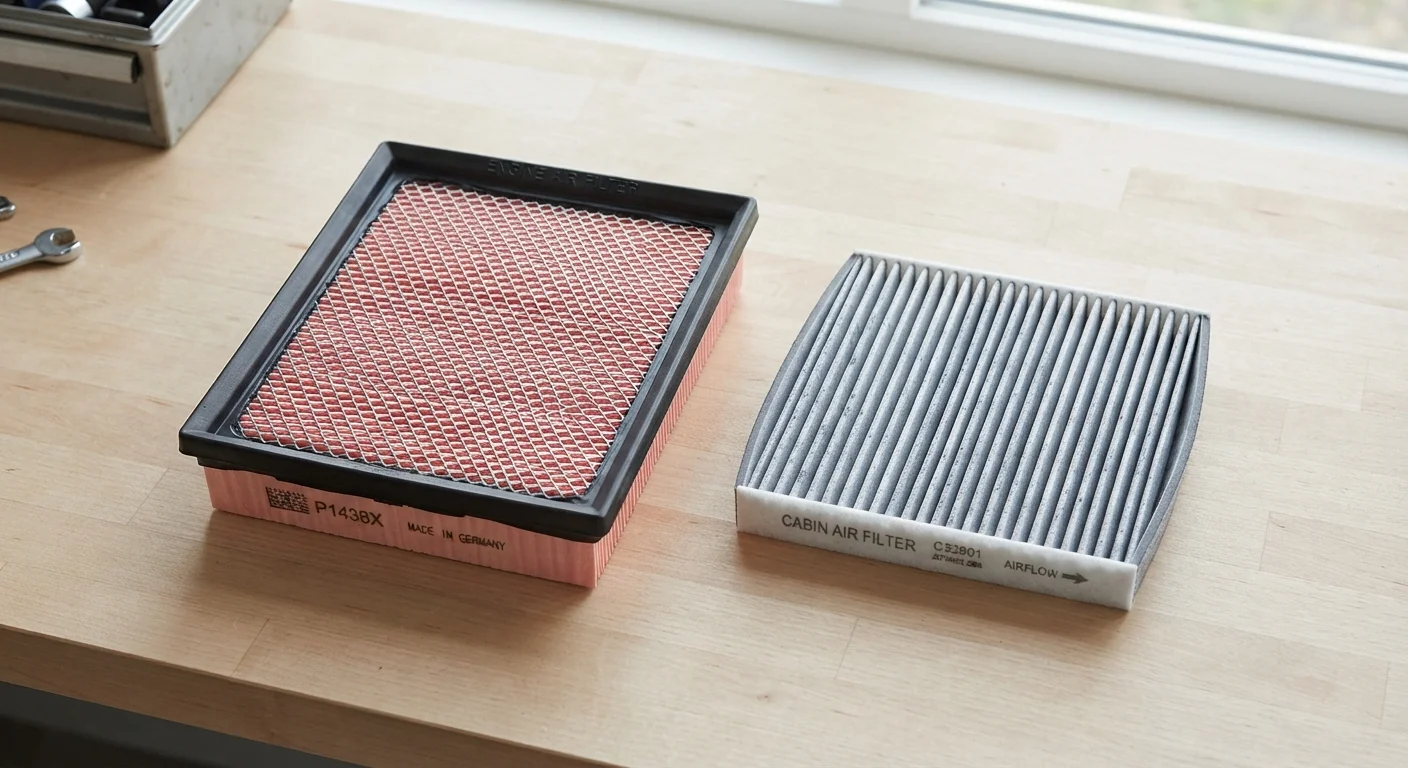
Option A
Engine Air Filter
The engine's first line of defense against dirt and debris.
Best for: Protecting internal engine components by keeping contaminants out of the combustion process.
Option B
Cabin Air Filter
The passenger compartment's shield against dust, pollen, and pollutants.
Best for: Improving air quality inside the vehicle for drivers and passengers, especially those with allergies.
What Each Filter Actually Does
Your vehicle has two separate filtration systems doing two completely different jobs. Understanding the distinction helps you maintain your car more effectively and avoid confusing one service for the other.
The engine air filter sits in the engine bay, typically inside a plastic housing connected to the intake system. Its job is to catch airborne particles - dust, dirt, pollen, insects - before they enter the engine's combustion chambers. Internal engine components, particularly pistons and cylinder walls, operate with very tight tolerances. Even fine grit allowed through can accelerate wear over time. The filter uses a pleated, paper-like media that traps particles while allowing sufficient airflow for the engine to breathe.
The cabin air filter is located in a completely separate part of the vehicle - usually behind the glove box, under the dashboard, or beneath the hood near the base of the windshield, depending on the make and model. It filters the air drawn into the passenger compartment through the heating, ventilation, and air conditioning (HVAC) system. It captures dust, pollen, mold spores, and in some higher-grade versions, even fine particulate matter and odor-causing compounds.
In short: one filter protects your engine's mechanical health; the other protects the air you and your passengers breathe.
| Criterion | Engine Air Filter | Cabin Air Filter |
|---|---|---|
| Primary Purpose | Protects engine from contaminants | Cleans air entering passenger cabin |
| Location | Engine bay, intake housing | Behind glove box or under dash |
| Typical Replacement Interval | 15,000-30,000 miles | 15,000-25,000 miles |
| Key Symptom When Dirty | Reduced power, worse fuel economy | Weak airflow, musty cabin odor |
| Who It Protects | The engine's internal components | Drivers and passengers |
| DIY Accessibility | Generally straightforward | Varies by vehicle model |
When and Why to Replace Each One
Both filters degrade over time as they accumulate debris, but the warning signs and replacement intervals differ.
Engine Air Filter
Most manufacturers recommend inspecting the engine air filter every 15,000 to 30,000 miles, with replacement when visibly dirty or per the owner's manual schedule. Driving conditions matter significantly - frequent travel on dusty, unpaved roads can shorten the usable life considerably. Signs of a clogged engine air filter include reduced acceleration, a noticeable drop in fuel economy, or in more severe cases, a rough idle. Some vehicles display a check engine light when airflow is sufficiently restricted, though this is not always the case.
Cabin Air Filter
Cabin air filters are typically replaced every 15,000 to 25,000 miles, though again, the owner's manual for your specific vehicle is the most reliable guide. Symptoms of a degraded cabin filter include reduced airflow from the vents, musty or unpleasant odors when the HVAC is running, and increased dust accumulation on the dashboard. Drivers or passengers who notice worsening allergy symptoms during in-vehicle travel may also benefit from checking the cabin filter's condition.
15,000-30,000 mi
Engine air filter typical service interval
General industry guidance; always verify the exact interval in your vehicle's owner's manual.
15,000-25,000 mi
Cabin air filter typical service interval
Cabin filters in high-dust or high-pollen environments may need attention more frequently than this range suggests.
One practical point worth noting: many drivers are aware of engine air filter changes because this service has been part of routine maintenance for decades. Cabin air filters, by contrast, are a relatively more recent standard feature and are sometimes overlooked entirely. Checking both on a regular schedule keeps the whole system working as intended.
A Note on DIY Replacement
Both filters are among the more accessible maintenance items on most vehicles. The engine air filter housing is usually straightforward to access in the engine bay, and replacement typically requires no specialized tools. The cabin air filter location varies more by model - some are quick to access behind the glove box, while others require more steps. Your owner's manual will describe the location and process for your specific vehicle.
That said, if you are uncertain about any step or if accessing the filter requires removing components you're not comfortable working with, having the service performed by a qualified mechanic is a sensible choice. Incorrectly reinstalling a filter housing can allow unfiltered air into the system, which defeats the purpose of the filter entirely.
Always confirm you have the correct replacement filter for your year, make, and model before starting - using an ill-fitting filter is as problematic as not replacing it at all.
Check Your Owner's Manual First
Manufacturer recommendations for filter type, location, and replacement interval vary considerably between vehicle makes and models. The owner's manual is the definitive source for your specific car. If you no longer have a physical copy, most automakers make digital versions available through their official websites.
The content provided on our blog site traverses numerous categories, offering readers valuable and practical information. Readers can use the editorial team’s research and data to gain more insights into their topics of interest. However, they are requested not to treat the articles as conclusive. The website team cannot be held responsible for differences in data or inaccuracies found across other platforms. Please also note that the site might also miss out on various schemes and offers available that the readers may find more beneficial than the ones we cover.